Why I’m Done With the Modern Game
Note: After yet another disappointing season of Baltimore Orioles baseball, I must have my rant. To non-baseball fans I apologize. Try to stay with me on this.
Baseball is a game I love eternally but hate more every year.
Today’s game isn’t the game my Dad played when he was drafted out of high school in 1943 by the Baltimore Orioles. He left the game he loved after 7 years to earn a living wage and start a family.
“Billy if you’d improve your batting average, you’d be in the majors,” his Triple A managers repeatedly told him. Never mind that his stellar defense was tops in the league.
Dad’s career average was .272. To put this in context, the current Orioles highest paid player, slugger Pete Alonzo, bats .267. He makes $31 million annually. As a team the Orioles are batting .234. Dad, playing today, would be a star in the majors. He came from an era of higher standards. The era of Babe Ruth, Lou Gehrig and Ted Williams.
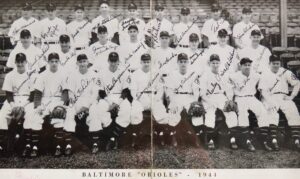
Dad is Third From the Left, Back Row
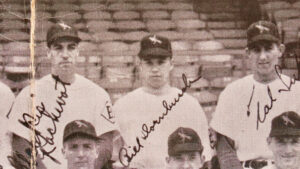
Bill Dornbusch
Major League Baseball (MLB) has become a business of fat-cat owners, data-driven, egotistical front office staff, and overpaid players so flush with cash they don’t know how to spend it.
Take the Baltimore Orioles, once the epitome of a winning team and a proud history. Their steady slide over the years into a team of mediocrity has been painful to watch. In 2014 they won the American League East with solid veterans, promising up and comers and great chemistry. The owners quickly dismantled their homegrown stars in the off season. “We are rebuilding,” they lied, fielding new prospects happy to take the minimum $500,000 salary. In 2015 the team struggled, while the owners got richer through a cheap payroll and lucrative TV deals.
“Be patient, the rebuild will take a few years,” promised the new hotshot general manager.
And while there’s a new owner now, the rebuild fans were promised never happened.
Meanwhile, teams looking for the best talent shell out millions. Ball players make more than brain surgeons. Top players command $50 million a season. Big bucks create entitled players who argue with umpires, flip their bats and seem to forget that baseball is a team sport.
The only ones who seem to be suffering are the fans. Since baseball began, owners have taken for granted that fans will show up despite all the crap they pull. Strikes, lockouts and cheating benefit their bottom line.
And year after year fans keep coming, buying $50 tickets, drinking overpriced, watered-down beer, wearing team hats and tee shirts. We know we’re abused yet want to believe in the romantic fantasy of baseball as America’s pastime. It’s like when you want to stick with someone but deep down you know you’re stuck in a toxic relationship.
For years I was one of those fans. I came of age in 1971, eyes like saucers, when the Orioles won the American League East with a line-up that included Hall of Famers Brooks and Frank Robinson and four 20-game winners led by ace Jim Palmer. Palmer had made his mark as a 20 year old in the 1966 World Series, tossing a complete-game shutout against the LA Dodgers. Days later, Palmer reported to his winter job selling men’s suits for $150 a week.
“I needed the extra paycheck to pay for groceries, hot water and electricity,” he told reporters.
How could a 13-year-old fan in a small-market city not let a team like this enter her soul? I fell in love. These players were home grown in local farm teams and part of an extended family to Baltimore fans.
Here’s the thing. All the bad-faith negotiations since 2014, covered up with lies to the fan base were the bust that did it for me. I’ve decided to pull the plug. Until owners and players have as much respect for the soul of the game as the financial side, I refuse to line their pockets with my cash.
I’ve been jerked around enough. Like Rhett Butler’s unrequited love for Scarlett O’Hara,
“Frankly… I don’t give a damn,” anymore.
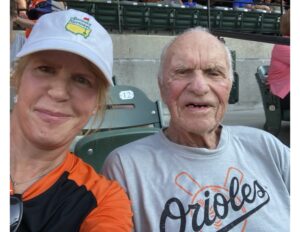
With Dad in Happier Days