Turkey, stuffing, and fermented cabbage? Hear me out.
Nothing captured our family’s Thanksgivings quite like Pop gleefully calling it “rotten cabbage” while piling it onto his plate—or that smell permeating the house. As kids, we hated it, though we all knew the truth: one day, we would probably end up eating it, too. The son of a son of German immigrants who arrived through the port of Baltimore in the late 1800s, Dad grew up on sauerkraut—alongside Sour Beef and Dumplings (Sauerbraten), warm potato salad (Kartoffelsalat), and other traditional German foods.
Dad had a deep, unwavering devotion to the stuff he jokingly called “rotten cabbage.” He didn’t just love it (eating it by the plateful for days after Thanksgiving); it was his lineage. When Lincoln declared Thanksgiving a national holiday in 1863, a quarter of Baltimore’s population was German. Sauerkraut quickly became part of their holiday feast, a tradition that caught on throughout Maryland.
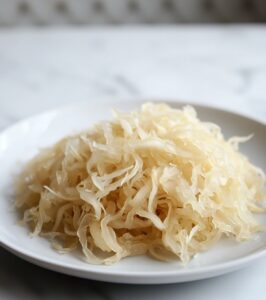
German Style Sauerkraut
My grandfather Harry made it by the barrel in his 1920s grocery store down on Hanover Street. Every fall, right after the cabbage harvest and fermentation, his barrel of tangy, pungent kraut became a popular mainstay in the store just in time for the holidays.
If you’ve never smelled fermented cabbage and turkey organs simmering together at 10:00 AM, consider yourself lucky. By noon, the scent of our German roots filled the entire house. Dumping a large spoonful of mint jelly into steaming peas was also a holiday staple—a recipe I suspect Mom developed just to bring a breath of fresh, sweet air into the kitchen.
Turkey carved and potatoes mashed, dinner was finally on the table. Dad, my German grandfather, and my uncle would all heap their plates with sauerkraut. The rest of us either passed or, like me, took a small spoonful to honor our roots.
Now that I’m older, I finally get it. I’m officially making the case for putting sauerkraut on your Thanksgiving table this year, Maryland roots or not.
Here’s why:
- It balances the plate: That sharp, tangy crunch cuts right through heavy mashed potatoes and rich turkey—plus, it makes a delicious next-day “turkey Reuben.”
- Your stomach will thank you: After a massive meal, fermented foods are great for digestion. Sauerkraut is packed with probiotics, vitamins, and antioxidants, which is why it’s having such a big comeback.
My parents and grandparents are gone now. The 1920s grocery store on Hanover Street is closed, and Mom’s kitchen is no longer. Sometimes the longing for those old traditions—and the heartache for Mom and Dad—is crushing. Still, it reminds me how lucky I am to have had all that love to miss. The happy and the sad, existing together.
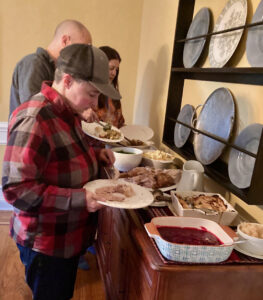
Note sauerkraut in lower right corner!
Today, my own small family has built new Thanksgiving traditions here in Connecticut. Every year, we still recite my grandmother’s blessing and put sauerkraut on our plates (though we skip the gizzards).
Why not give it a try on your table this year? Nobody expects to see it next to the cranberry sauce—a sure way to get people talking.
A Quick Note on Preparing Sauerkraut:
- How we make it now: I like the crispy, refrigerated kraut sold in bags or jars We simply serve it right from the bag, letting it come to room temperature. Shelf-stable cans and jars work fine too. Just keep in mind that only the refrigerated kind has the live probiotics. Heating it up kills them off, so skip the stove if you’re eating it for the gut-health perks.
- Mom’s traditional version: For Mom’s (Betty’s) classic recipe, dump a 14-oz can or jar or a 16-oz bag of sauerkraut into a medium saucepan. Add 1/2 cup turkey or chicken broth along with turkey gizzards or a little pork. Simmer for at least 3 hours.
- A modern twist: My mother-in-law made this sauerkraut recipe from Gourmet Magazine when she hosted my family for Thanksgiving one year. It’s a great modern take!
-

Mom & Dad, Thanksgiving 2010
So, have I made my case for Thanksgiving sauerkraut, or are you still skeptical?