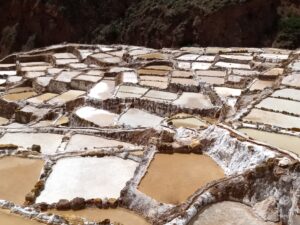
Our guide rounded the corner of a long, winding road through the Andes Mountains and we came upon the bleached white salt ponds. Nestled into steep, rusty brown slopes in the Sacred Valley of Peru are the Maras Salt Ponds (Salineras de Maras). What a striking site they are! Like huge, earthy-colored mosaic tiles.
Maras is 30 miles northwest of Cusco, once the capital of the Inca Empire. Set at an altitude of 11,150 feet, it’s the gateway to the Inca Trail. We found ourselves here the day before our trek began with Mountain Lodges of Peru that would take us all the way to the mountain citadel of Machu Picchu.
Built in AD200-AD900 by the Chanapata, an early Andean civilization pre-dating the Incas, there’s over 5,000 ponds. Each belongs to a local family who mine them just like they did back then.
An ancient underwater salt water spring canal feeds the ponds. The process is completely natural. When keepers want to fill their pond, they open a notch to allow the salty water to come in. Once the pond is full, it is left to dry until the salty water evaporates in the arid Andean air. After it’s all dried up, the scraping of the pink salt crust begins.
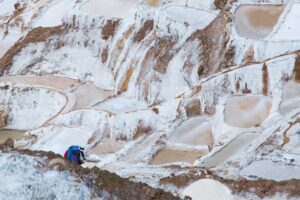
Daily admission is restricted to respect the families and prevent the area from becoming overrun by tourists. Walking directly inside or around the ponds is restricted to protect the fragile structures and local family cooperatives. Our guide, Luis, led us on cement, panoramic trails for spectacular views. He had a warm and earnest energy about the area. We watched a woman actively mining the salt in her family pond.
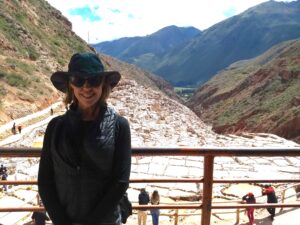
It was windy that day and my hat blew off, right over the railing, landing into the salt ponds! Luis instinctively bolted down the trail, spoke to an official and jumped a railing. Gingerly navigating the narrow edges of each pond until he reached the one where my hat lay, he leaned over and grabbed it. When he handed it back to me, he was barely winded! The whole ordeal took less than 10 minutes.
“Thank you so much! I’d be totally out of breath!” I beamed.
“I live here,” he shrugged, grinning. I guess living at 10,000 feet acclimates a person.
Spending time at this magnificent site was unforgettable. After our descent, we found ourselves in the local marketplace—kind of like when you exit a museum through the gift shop but super rustic. Small, open-air local stalls sold kitchen and bath salts made from Maras pink salt. Filling my basket with various salts, I was thrilled to spot salt-infused local chocolate bars and picked up several of those too. Each bar was aromatic and complex, with a deep and intense flavor profile. Hints of the local salt took the bars over the top.
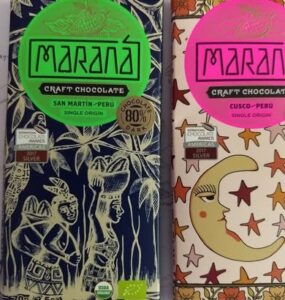
Peru and cacaoCacao is the seed (bean) of the cacao fruit, which is used to make chocolate. The beans are fermented, dried, roasted, and processed into products such as cocoa powder, cacao nibs, and chocolate. More share an ancient, intimate history. Legend has it that the cacaoCacao is the seed (bean) of the cacao fruit, which is used to make chocolate. The beans are fermented, dried, roasted, and processed into products such as cocoa powder, cacao nibs, and chocolate. More shrub originated in the foothills of the Andes where it was first domesticated then introduced by the Maya to Central America and Mexico. Stories aside, one thing’s for certain: Peruvian chocolate is simply in a class by itself.
I’m thrilled to finally get a chance to visit here, three years after my original post related to the Maras Salt Mines. Especially now that our salted caramels—topped with authentic Maras salt—won ‘Best in State’ at the prestigious 2016 Connecticut Specialty Food Awards!
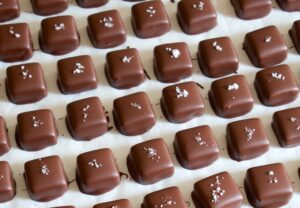
Our salted caramels made and topped with Maras Salt
Peruvian women collecting salt from Maras salt pond. (photo courtesy of JC Dorgan). The rest are mine.